(Author’s Note: Wow, this turned into a long post of my ramblings about personal saddle discoveries I’ve made over the years, because I’ve literally been working on it, off and on, all day. I think there’s a point to it. It might just be buried somewhere in there.)
So I grew up with the riding school of thought that said it didn’t matter what the saddle was like, you learned to ride through it. As long as the seat vaguely fit, there was no such thing as taking into account the saddle’s natural balance, leg position, and whether or not it truly fit.
When you end up riding in three different saddles over the course of one show day, and spending a lot of time climbing in and out of those saddle in between classes, it’s easier to adopt that school of thought, and when you subsequently watch videos of yourself riding, just chastise yourself for not spending enough time working on keeping that lower leg still.
Must ride without stirrups more, was a common thought.
Imagine my surprise when I got into distance riding and learned that, Wow, improper saddle fit was making this a lot more uncomfortable than it really has to be. Also on the “Why Did I Learn This Sooner?” list was the concept that things like rise and twist in a saddle make a huge difference in lower leg stability and the ability to retain one’s position instead of falling forward in a heap every time a certain pony would root her head and yank forward on the reins.
I can stop my horse without completely falling apart, position-wise?
It was a revelation.
Never mind the fact it took several years of distance riding, quite a few hours in the saddle, and going through multiple saddles before all these little revelations finally connected in my brain.
Hey, maybe there’s a reason for the fact I’m constantly fighting for a proper position and balance, other than the fact I might just suck as a rider?
But it’s made for an interesting look back at old ride photos and such.
Not going through my old show photos, mostly because they’re a disorganized mess. Someday I’ll get them sorted into photo albums. Today’s not that day.
But I rode in five different saddles when I was showing:
A Circle Y Western Equitation saddle. After Mimi and I both outgrew the first one, I got pretty much the same saddle, in a larger size and with more silver. I couldn’t help but have decent equitation in this saddler, especially the second one. The leather on it was so thick, stiff, and pre-formed, my legs weren’t going anywhere. It was just a matter of keeping my upper body in roughly the same hemisphere as my legs.
When I started, I already had a saddle: a Miller Collegiate Close Contact. I actually had the saddle long before I had the horse…my parents got it for me the first year I started riding. So I literally grew up with that saddle. It worked for Mimi and I for several years, and then my legs finally outgrew that saddle. (I was very excited about this. I was really quite short for my age until about halfway through high school. Now I’m just short-approaching-average. But I’ve gotten over it, mostly because it means I can still ride ponies.)
That saddle was literally the classic definition of “postage stamp of leather.” No knee rolls, very flat seat. No wonder the horse I rode for that first year was able to launch me with such ease. Short little legs didn’t offer a lot of grip, and virtually nothing by way of saddle security.
I replaced that saddle with a Stubben and finished out my show career in that one. Mimi eventually outgrew it, though, and by the time we were done showing, it was definitely too narrow for her. I hung on to that saddle for a number of years, out of sentimental value, and finally just sold it about a year and half ago…to my friend Kaity. So I know it’s in good hands and being used instead of gathering dust in my bedroom. And it was a step up from “postage stamp”: tiny knee rolls and a flat seat. These days, I’ve found that while I still adore and prefer an English-style saddle, I like more security in the form of a deeper seat and substantial knee rolls.
And of course I had my Big Horn Barrel saddle. I used this for most of my lessons and for running gymkhana at the shows. When I started distance riding, this was what I started with. It got me through all of our conditioning up to our first NATRC ride, through the first ride, as well as the next one. All in all, I probably did distance in that saddle for about a year.
Shall we play several rounds of “What’s Wrong With This Equitation?” with some of my old ride pics? (I apologize for the quality…I should have scanned the pics before I stuck them all in an album. Actually, I did have them scanned. And then the computer ate/wiped the flash drive they were on. Nice.)
 |
| photo by Jane Gray Impressions |
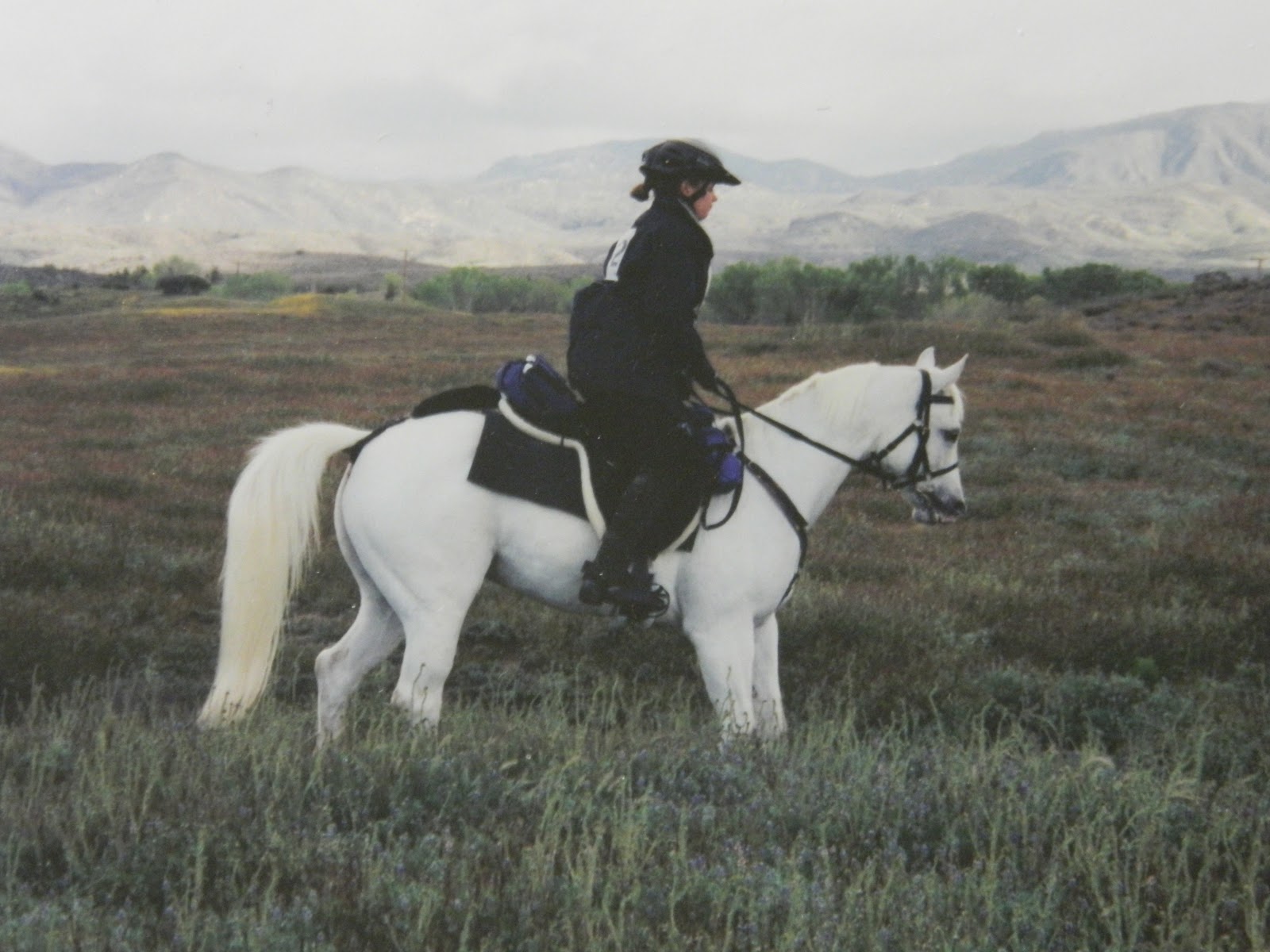
Awww, our first NATRC ride, First of Spring, April 2002, El Cajon, CA. Gotta say, I don’t think I’ve ever seen the pony have that much knee action. Sooo, the rider. This one does a really good job of illustrating the faults I tend to make: I lean too far forward., and my legs swing too far back. Back then, I was also still in my “jockey-esque stirrup” phase left over from many years of huntseat riding, in which I equated shorter stirrups with great security. Not always the case…but that one took me a long time to figure out.
The main problem with the Big Horn is it has an extremely wide twist. Everything else is good…but man, it’s really hard to get your legs on the horse and keep them under you. Which further exacerbates my natural tendency to lean too far forward.
The leaning forward thing: It’s my security blanket. Even though it’s gotten me dumped while jumping more times that I can count, and tumbled over the horse’s shoulder, and made me eat mane on a frequent basis, I have a hard time giving it up. To me, sitting back too far makes me feel too vulnerable to sudden forward bursts of speed, or to the possibility of being somersaulted off over the butt ends, which is a far more traumatic happening than a front-ways dumping. Done both, and there’s nothing I hate worse than the backward-flip sensation of the horse shooting out from under you.
But all of this is a compounding thing. If I can’t get my legs under me, I have a hard time sitting deep. If I can’t sit deep, I can’t take up on the reins and resist the pulling. Her pulling on the reins in turn pulls me forward, moreso than I’m already inclined to be.
This was a pretty habitual thing, so you can see why I just chalked it up to “Some people are just more naturally gifted than me and I just suck at this whole ‘stable position’ thing.”
Exhibit B:
 |
| photo by Jane Gray Impressions |
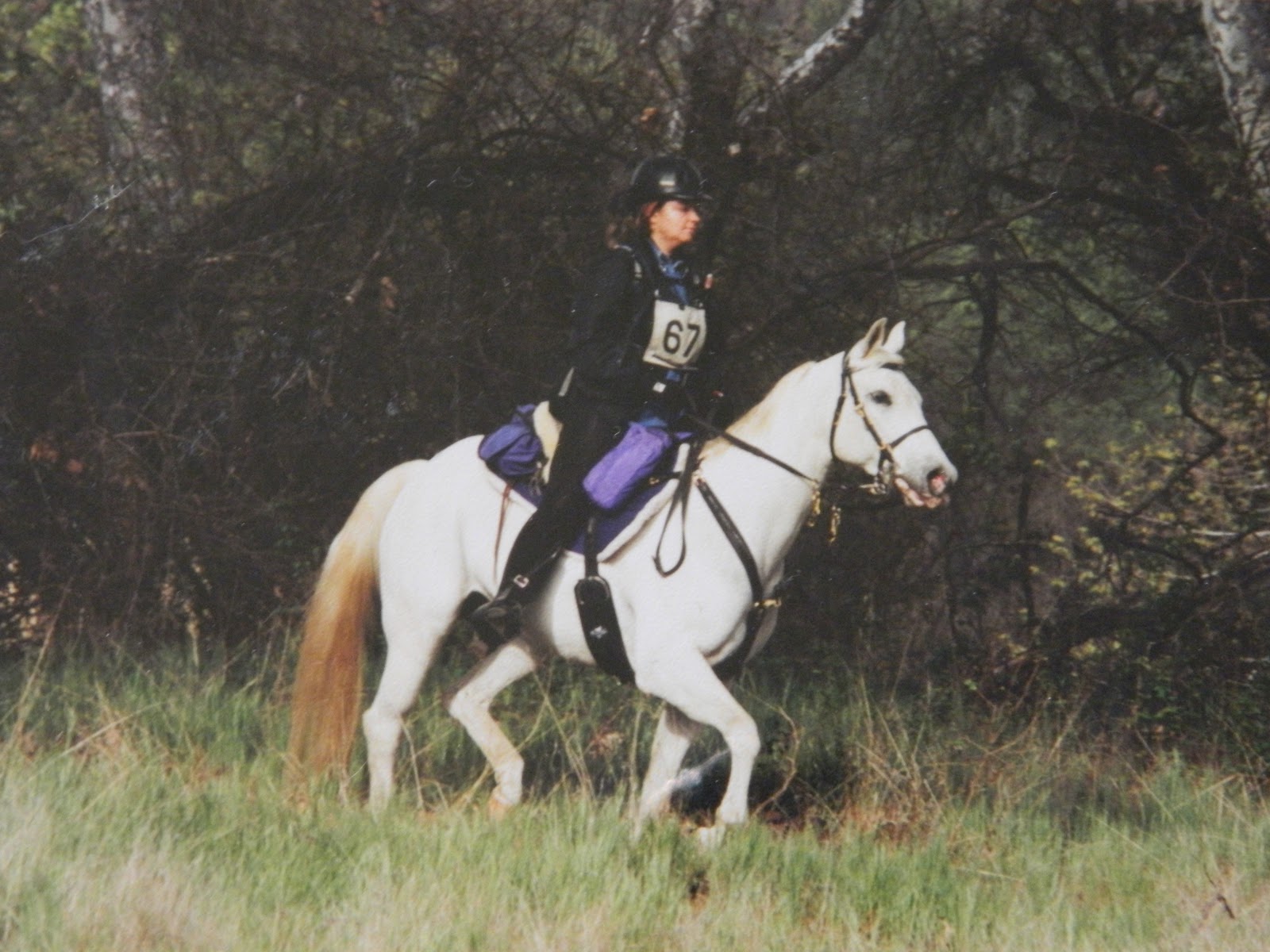
First of Spring NATRC, April 2003, Warner Springs, CA. New saddle! Well, next saddle after the Big Horn. After surviving two NATRC rides without the pony having a meltdown, I felt more comfortable exploring saddle options that didn’t include the pseudo-security blanket of a Western saddle. One of my knees was also occupying the Complaint Department on a regular basis, so I wanted the flexibility of English leathers again. Plus, I started riding English…riding an English saddle and the accompanying equitation is as natural to me as breathing.
The saddle I chose was a Wintec Endurance. I liked the changeable gullet option, since my pony kept broadening out. Riding in the Big Horn had me spoiled to the whole synthetic saddle/lack of leather cleaning thing. (I’ve since ditched that notion again. I love nothing more than high-quality leather, and I actually find saddle cleaning to be soothing.)
Too bad that new saddle didn’t take care of any of the above-mentioned problems. In the Wintec’s case, the twist was too narrow. I didn’t have a good base of support, so I tended to be all over the place, again. Legs too far back, leaning too far forward, pulling pony making the whole thing worse.
We’re not going to go into training, bits, horse misbehavior, rider error in this post. I’ve since figured out what I did wrong, what I didn’t know back then, what I’ve since changed, et cetera. I’m strictly looking at how saddle fit for the rider can affect riding position and efficacy.
Moving on.
Fast forward a few years and I got a Free ‘N’ Easy Trekker. It was a saddle I really liked, especially the option of the movable stirrup bars. I didn’t connect all the dots at the time, but I definitely felt like I was riding better.
Unfortunately, I only ever did one ride in it, and the one ride pic I have doesn’t show a good enough angle to actually see if my memory is as good as the reality was. I ended up selling that saddle when Mimi (again!) outgrew it. It was marginal on width to begin with…hindsight being what it is, I probably should have exchanged it right off the bat for a wider tree.
Ah, hindsight.
So I went back to the Big Horn. By this time, I had sawed the horn off (no more jabbing me in the ribs) and replaced the stock courdura fenders with much thinner, more flexible biothane ones. Ah, much better. At least on the knees. It still didn’t solve the whole “this twist is way too wide” problem.
I did several LDs in that saddle, and I could manage 25 miles. But then I started eyeballing the possibility of moving up to 50s, and could not see myself riding 50 miles in that saddle and still being able to walk at the end.
Enter my current saddle.
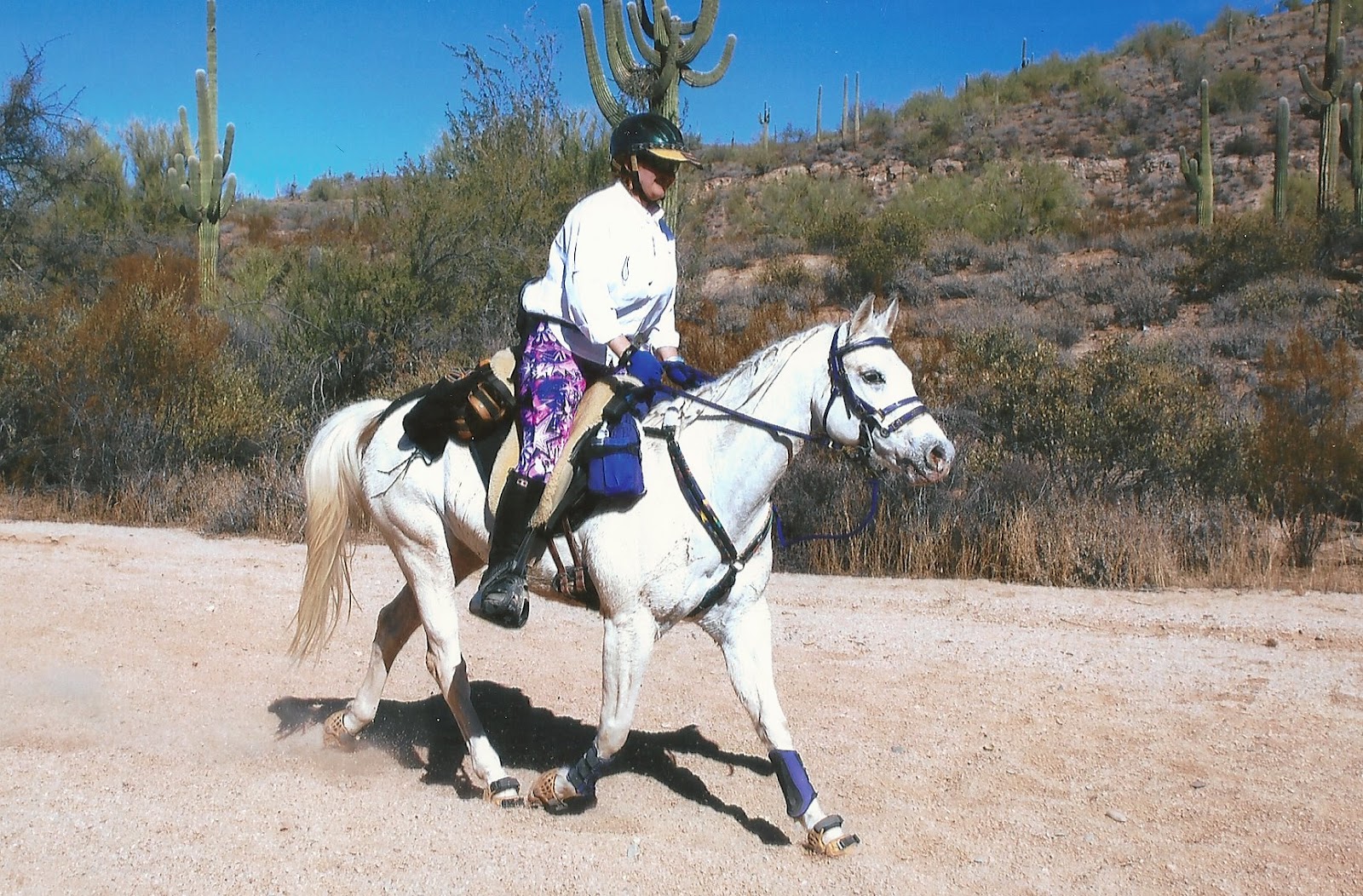
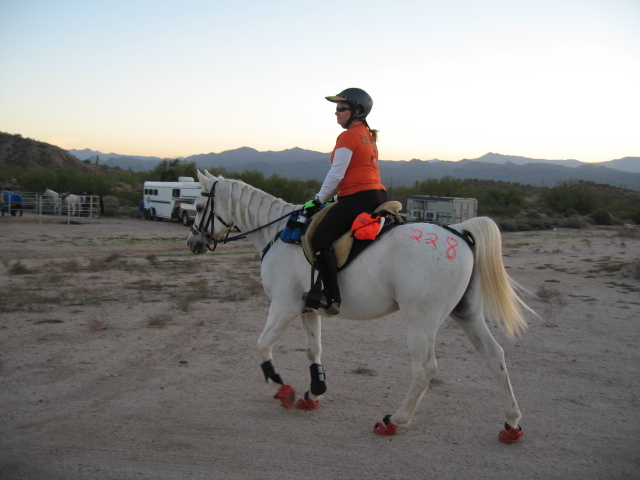
It’s a Duett Companion Trail. It fits Mimi perfectly, and I feel like I can actually ride in it. I’ve had the saddle for five years now, and I’m thrilled with it. It was the saddle that finally connected the dots for me: proper stirrup position and balance in the saddle makes for a secure lower leg, and a more secure body position.
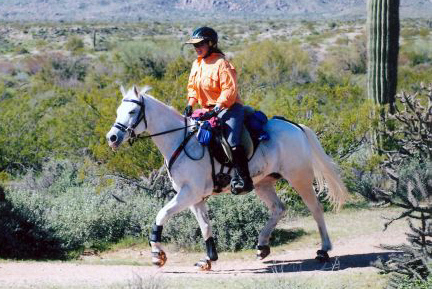
Still leaning a bit forward…it’s a chronic problem. But I’ve actually got my leg on the horse and in a good position. Because I’m not fighting the saddle and fighting for security, it also means less fighting with the pony.
And that right there is about as good as it gets for me. Good leg position, fairly upright.
But of late, I’ve noticed that I’ve been feeling a little floppy, for lack of a better term, in this saddle. Really reaching for my stirrups, lower leg starting to do its “errant waving in the breeze” thing. Huh???
Okay, so, here’s the deal: The Duett is a 19″ seat. I’ve typically ridden English saddles anywhere from 17″ to 18″. The Duett is sized on the small side, and when I got it, I waffled between the 18″ and 19″. The 18″ felt just right…but I figured that by the time I added a sheepskin cover and rear cantle packs, that would fill in the extra space.
Which worked really well for the past few years…until recently. This past fall, I embarked on a pretty significant lifestyle/dietary change. Nothing drastic or extreme, just cutting portions and eating very balanced, sensible, real foods, combined with walking every day and gym workout and/or at-home routines with stretch bands. It’s working: I’ve dropped 25 pounds since the fall, as well as extra waist and thigh inches.
My saddle is a bit too big for me now.
I solved the problem by shortening my stirrups up a hole. Ah, that’s better. I’ve got my base of support and good leg contact back. And everything else about the saddle still works: good leg position and support, good knee block placement…I’ve got got a little extra room back by the cantle packs now.
But all of my saddle trials and errors have really shown me the importance of a good trial with a saddle before committing to buying one: It’s really hard to know if something’s going to work without trying it.
And I’ve decided that having a saddle that works for me the rider is just as important as finding one that works for the horse. Because if I’m not riding well, that’s going to negatively impact the horse, no matter how well the saddle fits them.
The next round of saddle shopping (whenever that happens) is gonna be so much fun…
 Go Pony • Go the Distance