As you might have guessed from the title, I have a love-hate relationship with using heart rate monitors on my horses. I will say that they have their benefits, but they also come with a full set of hair-yanking annoyances.
To start, let’s discuss technical details. There are two main brands of equine Heart Rate Monitors on the market: Polar and V-Max, and two styles, either the belt or the electrodes. I have one of each brand and one of each style.
The Polar HRM I have is actually a human chest belt, the T31 transmitter, adapted for equine use with a homemade neoprene belt. They do have an actual equine belt now as well. I have an extremely basic Polar HRM watch that does nothing more than give you the heart rate reading when it’s connected.
 |
| the belt style in approximately the correct position |
The nice thing about the belt is that it can stay on the horse once you pull the saddle, so you don’t need a handheld unit to monitor the heart rate.
The cons that I experienced with the belt where that, due to Mimi’s barrel-like conformation, it was extremely difficult to keep the transmitter in the proper position. It had a tendency to slide around her barrel, sending some truly outrageous readings to the watch, and when I would glance down in alarm (“Surely we’re not walking at 200+ bpm!”), I would see the transmitter had migrated to the top of her withers. There’s a velcro strap around it that you can wrap around the breastcollar to keep it from migrating backwards, but that doesn’t help with the spinning around.
I will say I never experienced that problem on horses with high withers.
The other major problem was the lifespan of the belts: Short. They are homemade from neoprene weight belts, so I can’t speak for the quality of the ones directly from Polar. I started using the belt style back when they were a DIY affair cobbled together from various offerings and the imaginations of creative people.
Although I never had a problem with it, something to watch would be the belt under the girth, and positioning of the transmitter so that it doesn’t encourage girth galls. A horse who is sensitive in the armpit area might have problems with that much “stuff” in there.
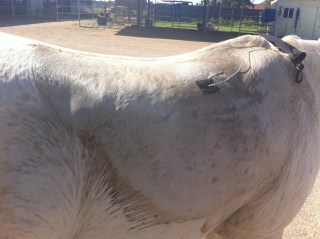 |
electrode style, showing the electrode that gets placed
under the saddle. second electrode gets placed on the
opposite side under the girth, approximately level with the
elbow, in the area you would place a stethoscope. The wires
attach to the transmitter, contained within the black pouch,
which can then get clipped to the saddle d-rings. |
The other style I own is the electrode style, this one from V-Max. This one is also very basic, although the watch displays both the heart rate and the time at the same time.
This was the first HRM I got, and aside from changing out the batteries in both the watch and the transmitter once, it has held together really well.
My quibble about this style is that it is fussier to put on: you have to position the electrodes correctly so that you get a good reading, and I would caution on placement of the under-saddle electrode that you use care to not place the electrode right under the stirrup bars or any higher-pressure area. While they are low profile, I have seen horses that develop white hair patches in the exact shape of the electrode over time.
It’s also something to pay attention to when unsaddling, particularly the electrode attached to the girth. It’s pretty easy to drop the girth and yank it away without disconnecting the electrode, which then might end up yanking the leads (wires) out of the electrode. But this style also doesn’t move once you have them in place, so as long as they are positioned well, they tend to given pretty accurate readings. (However, if you are walking along at 200+ all of a sudden, lean down and check that your girth electrode hasn’t gotten yanked out and is now merrily dangling next to your horse’s side.)
Those are some of the mechanical/technical pros and cons of HRMs. Let’s talk about my own personal philosophy and approach to their use.
A heart rate monitor is a TOOL. It is not a substitute for the FEEL of a horse.
It is not a speedometer, or tachometer. It is a piece of electronic equipment designed to give you feedback you might not otherwise get. I do not ride based off of the HRM, but I use the HRM’s feedback to support what I’m feeling or not from the horse.
I would say learn to feel your horse and know them before relying too much on technological input. I put a lot of stock into gut instinct, and I generally think I have a pretty good read and feel of a horse. I know that I personally like getting feedback: It’s really great to know how fast the horse is recovering, or what their HR tends to be at various gaits, or determining what speed within a gait might be most efficient for them.
But if you’re a worrywart like me, a HRM can be an instrument of torture if you pay too much attention to it. Which then goes back to my original approach of “treat it as a tool.” If you have a high reading, take a quick stock and assessment: Did the belt rotate? Is an electrode loose? Bad connection? If a reading that is concerning persists, that’s when the feel of the horse comes in to play. Are they trotting along happily, breathing steady, feeling “normal?” Then it’s probably a technological issue, or a temporary blip. What’s your gut telling you? Is there something about your horse that is not quite “right?” If so, maybe the HRM is backing up what your gut — and your horse — is telling you.
Here are some specific-to-me examples of when I’ve benefitted (or not) from using a HRM:
— Mimi can be a very subtle horse about telling me when something is wrong. Both times she had a tie-up, the main indicator was a hanging pulse. Not high, just hanging — extremely uncharacteristic for her, coupled with a lack of enthusiasm for moving out willingly. The lack of wanting to move out — probably the most uncharacteristic sign from her there is a problem, since she is the Go Pony — was what made me look at the HRM, and the hanging numbers confirmed by suspicions. Fortunately, both times were caught very early on in the process, before they could become a major problem.
— When I took Beamer to a ride, using the HRM was extremely beneficial because he could be somewhat of a sandbagger. He might act like he was all used up…but when he’s walking at 48 bpm in a sand wash after 25 miles, he wasn’t too exhausted…he just thought he was. In that case, having the HRM didn’t actually help me get him to go faster — when he decided he was done, that was that — but it did reassure me that I hadn’t actually pushed him too hard.
— It’s been a handy tool when I’m riding horses I’m unfamiliar with. Not that it helps a ton while riding, since I’m usually not familiar with their standard working pulses — a bit alarming at first to be used to one who trots at 120 only to get on one whose trotting average is 140 and you start to wonder if there’s something wrong…no, that’s just the horse — but it does help to establish some basic patterns. It doesn’t matter the actual numbers in the sense that, if they’re going along at one close range for a while, then it starts shooting up, now might be a good time for a breather.
- When riding Liberty at Prescott, the HRM actually was a good tool in helping me figure her out. She’s a brave, bold, forward horse who is happy to motor along pretty consistently (especially for a greenie), but she wasn’t showing signs of wanting to take a breather on her own. From what I remember, her trotting average was around 120, so when her HR started to jump to 135-140, that’s when I would ask her for a walk break, and usually several minutes later, she was ready to go again.
- She did hit a wall partway through the ride, but based on her HR, it was more mental than physical, and I actually chalk that one up to rider error. I got pretty caught up in how solid she was and how much fun I was having riding her that I, quite frankly, forgot she was still a green horse on only her second ride. She led the first 9 miles of the ride, and I think she probably got a little bit overwhelmed mentally. Rather than freak out, she just stopped and asked, in her own way, that the other horse be the one to lead for a while. She was more than happy to keep following.
- I monitored her HR, and it stayed in the same low patterns, so my conclusion based on that was she was still physically feeling good and not being overly taxed — but she needed the mental break. It worked. She got a good break for the next third of the ride, and then after the vet check, we made a point of alternating who was leading or following much more frequently — switching off every mile or so — and by that point, she was happy to take the lead and move out again.
— It’s a pretty nice tool to have at a VC, to be able to know when your horse is down, or for learning how fast they take to drop to ‘x’ point.
- I “hide” my HRM screen from pulse-takers, so as to not accidentally influence what they’re hearing. I want to know if they’re hearing something different than what I might be getting.
- That said: This is again another area for “technical difficulties.” Don’t rely entirely on the HRM — know how to take your horse’s pulse manually or with a stethoscope, since the monitor might not be reading perfectly accurately (one of the rides I was at this spring, my HRM was consistently reading four beats higher than what P&R people and vets were getting) or may be having some issues.
I think that just about exhausts my HRM repertoire…I’m by no means an expert, this is just personal opinions gleaned off of the past ten years of experience in messing around with them.
For those that are curious, I am currently using the V-Max electrode system. After going back to it, I’m on the fence as to if I like the belt system anymore or not.
If there’s something I didn’t cover, or any questions I raised, please ask!




 Go Pony • Go the Distance