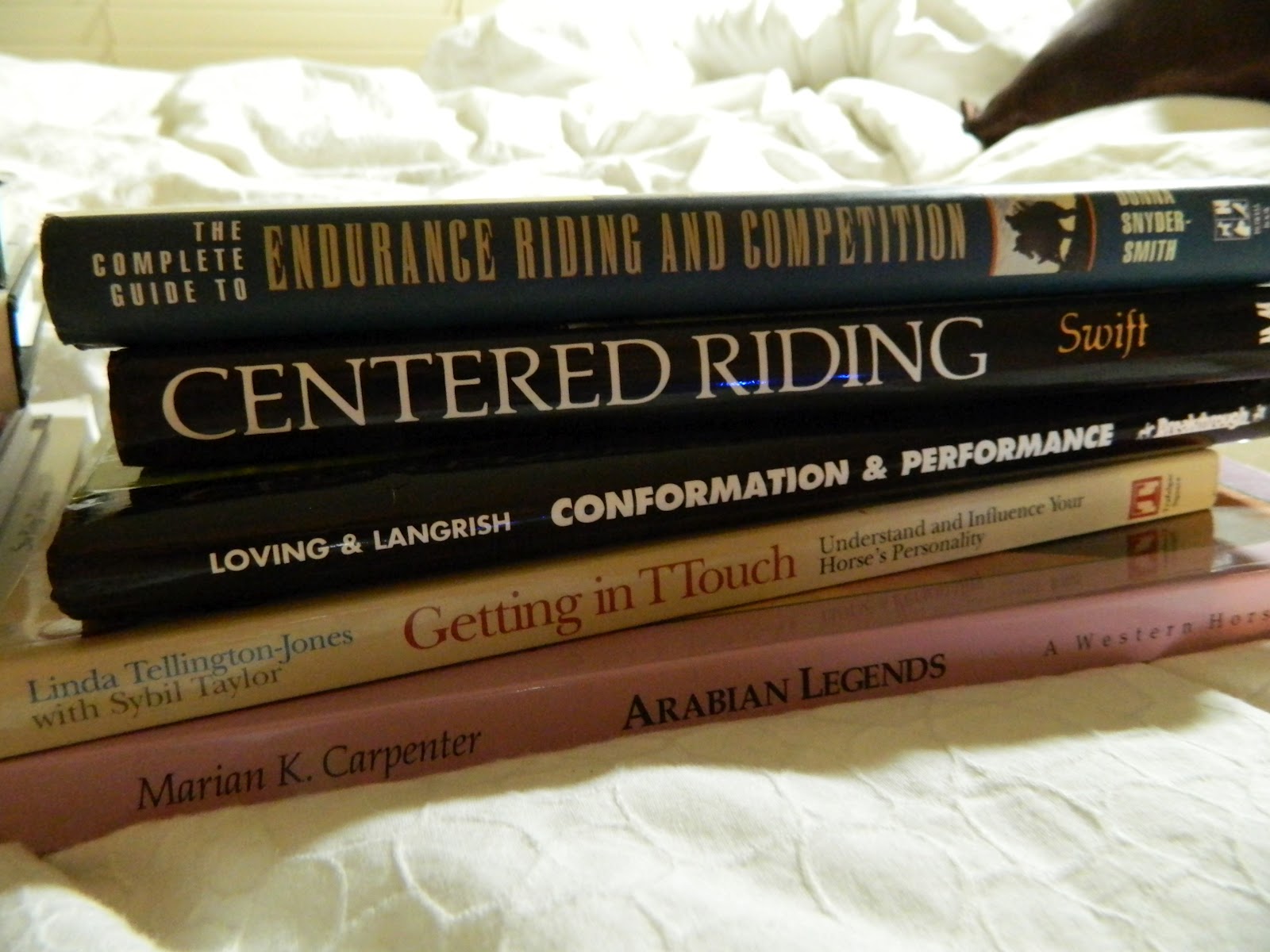
Top Ten List: Equine Books

Inspired by the idea of the ‘Top Ten’ in endurance, I’m presenting my Top Ten list of favorite equine-related, non-fiction books.

I’m a crazy bookworm who is an absolute research geek when it comes to topics I like.  (Pretty much anything relating to four hooves, a tail, and a whinnied greeting.  But my research shelves also contain tons of writing stuff, and a ton of cookbooks.  To further the eclecticism: An assortment containing everything from theatre to home decor books.  The only unifying theme among all of these is that they’re topics that are interesting to me.  Show me a math/chemistry/physics book and my eyes glaze over.)
My Top Ten Favorites
The Complete Guide to Endurance Riding and Competition, by Donna Synder-Smith
Though it was written quite a few years ago, much of the information is still relevant today and it’s my favorite go-to endurance guide.  I’ve been skimming through it as a refresher course with the thought in mind that one day, I am going to have to bring a new horse along in endurance.  I have several endurance-related books in my library, and I end up going through all of them, but this one ends up being the one most frequently grabbed.
Centered Riding, by Sally Swift
A timeless classic that should be on every bookshelf.  Even if you’re not interested in any kind of arena-based competition, this is a valuable resource as a book because it gets down to the functional basics of riding that are important no matter what your discipline.  I am constantly learning from it, even with close to 20 years spent in the saddle.
Conformation & Performance, by Nancy S. Loving, DVM, photos by Bob Langrish
This was actually one of my textbook (!) for an Equine Science class I took in college.  Best class ever…well, toss-up between that and a Theatre Movement class that involved stage combat…but the equine one turned out to be a little more relevant.  Warning: Once you read this book, you will never be able to look at a horse without finding fault in their conformation, and you start wondering if you’ll ever find a perfectly-conformed horse.  Hint: You won’t…it’s a matter of learning what conformation flaws you can live with and which are unacceptable.  The photography is a major part of the book, and makes it really easy to identify each conformation aspect that is being discussed.
Getting in TTouch, by Linda Tellington-Jones
This book fascinates me.  I absolutely love analyzing a horse based on their physical characteristics.  I’ve applied the principles in the book to enough horses that I’ve know to find it’s eerily accurate.  I love horse “psychology” for lack of a better word, knowing ‘how’ and ‘why’ a horse is going to react to something the way they do, and these kinds of books have gone a long way towards altering my perception of working with the horse and turning them into your partner, versus an automatronic sheep.
Arabian Legends, by Marian K. Carpenter
I am a lightweight, a complete novice, when it comes to bloodline research.  I know just enough to know what I like and what to avoid.  But bloodline history is fascinating to me.  Especially with Arabians.  They’re such an old breed, with so much history tied in to them, that just going through this book is an interesting read.

How Good Riders Get Good, Denny Emerson
A new addition to my bookshelf.  I started following Denny’s blog a few weeks ago, and very quickly ended up purchasing the book.  I’m only a little ways into it at this point, but already loving what I’m reading.  Not so much a technical manual as it is a mental strategy guide and examination of you as a person and how that translate into you as a rider.  He doesn’t pull punches, but lays out the facts, sometimes in ways that’ll make you cringe to yourself when you realize you’re guilty of doing exactly that thing.  But he also manages to do it in such a way that it never feels like a personal insult or attack, but rather a bald statement of fact and motivation to look for how to fix/change it.  Looking forward to finishing this book…and then re-reading it.
Ten Feet Tall, Still, by Julie Suhr
I must get Julie’s new book.  But until then…I love this book.  I love her writing style…she’s a fantastic storyteller and I love that she lets so much of who she is come through in this book.  It’s a memoir, not a technical manual…and yet, there is so much to learn from it.  It’s entertaining, and her description of riding Tevis has brought tears to my eyes on a number of occasions.
The Level Best for Your Horse, by Dale, Ron & Bob Myler
I am a certified bit geek.  I love collecting them…love figuring out whether they work or not…and this book really opened my eyes.  I learned things about bits that I either didn’t know, or had a pretty drastic misconception of.  I will never stop learning or trying to further my education, and this book is one of those really good examples of why.  I also just love reading about all of the different options for bits and how they all work.  I could go broke just buying bits.
Correct Movement in Horses, by Gabrieke Rachen-Schoneich and Klaus Schoneich
I was introduced to this book at the Dr. Kerry Ridgway seminar I attended a couple of months ago.  Many of Dr. Ridgway’s principles of training and balancing of horses comes from this book.  This is a really good, even further in-depth explanation of the problem of “the crooked horse” and training solutions for how to go about solving it.  I’ve not had a chance to put the theories into practice yet, but I’m enjoying adding this knowledge to my repertoire.
Horse Owner’s Guide to Natural Hoof Care, by Jaime Jackson
My go-to resource when my original trimming mentor Kirt Lander is unavailable.  I like his approach to trimming and it’s written in such a way that I don’t feel too overwhelmed.  Most of my trimming is done by instinct or feel…which is why I can’t teach other people how to trim…but of late, I’ve been wanting to expand my technical knowledge of barefoot a lot more.  (I think I want to get my hands on the Pete Ramey DVDs at some point.)
It was actually kind of hard to narrow it down to even ten…I’ve got another half dozen or so that I really like.  Decisions, decisions.  And I think I might continue this Top Ten list trend, just moving around to various topics.

The newest hot topic : Intro rides

I apologize in advance for any perceived “shooting off of my mouth.”  I am under-caffeinated, with a benedryl  hangover (allergies + benedryl taken at bedtime that hasn’t quite worn off).  I don’t set out to personally attack or offend anyone.

Ridecamp and the endurance blogosphere are lit up like a fireworks factory right now over the topic of “intro rides.”

To me, it seems very much like another spin on the LD vs Endurance debate…but what do I know?

My two-bit summary of what I’ve managed to piece together from all of my lurking: The debate is whether endurance rides should sanction 10-15 mph “short” rides as an intro for newbies or people really not interested in longer distance.  That seems to be the heart of it, at least.  There’s some spin-off suggestions of adopting more of a “competitive trail” model.

For what it’s worth, here’s my opinion as someone who is still very much an endurance newbie, coming out of a background of NATRC.

I like the idea of intro rides.  They’re fairly popular here in the SW.  I think at least half of the rides I’ve been to have offered some kind of intro ride.  Sometimes they’re wildly popular — the 12-mile fun ride at Man Against Horse always drew as many day riders as the 25 and 50 combined (usually 60+ the years I’ve been there).  I think the fact it was a poker ride probably helped…anything that involves gambling, alcohol, and horses is pretty much guaranteed to succeed in Arizona.

When I volunteered at the McDowell ride this past fall, an intro ride was offered.  I think we had maybe a dozen people sign up.  They got a mini ride briefing in the morning during the time period between getting the 25s/50s/75s out and when we expected the riders coming in off their first loops.  They had maps, their own ribboned loop to follow, and grease numbers to scrub off their horses butts if they wanted.  We had an experienced endurance rider leading the group, and they had the option of staying with her the whole time or riding ahead/behind at their own pace.  I think it was something like a 12-mile loop they did, and at the end, they had the option of doing the pulse-down/vetcheck routine.  And they got completion t-shirts.

I don’t know what it cost management to do this.  I don’t know if it was profitable.  It didn’t take a whole lot of extra time, because they went out on a loop that had already been marked as one of the loops for the 25, and timed in such a way they would be off of it before the 25s started on that loop.  I don’t know if it piqued any of the participants’ interest enough to move up to 25s.

As someone with an older-and-crunchy horse, I could see doing intro rides with Mimi.  I’m too scared to even ask her to do a 25 anymore…but mentally, she could benefit from still getting out and “competing” in her mind.  10-15 miles would be right up her alley.  Yes, I can do that kind of mileage in a training ride.  I’m not paying for the miles…I’m paying for the ride atmosphere you can never quite replicate at home.

However…I don’t think AERC should sanction these mini-rides.  Leave it open to ride manager discretion.  More sanctioning means more man-hours to manage tracking miles and participation.  More man-hours means more cost — more people to pay, more awards to fund.  Make money off of collecting the day fees, offer riders a hopefully welcoming environment, and maybe that’ll inspire them to move up to 25s…then 50s…and maybe someday, Tevis.

Or they’ll continue doing fun rides and management can continue to collect day rider fees off of them.

There is one area of this discussion I vehemently disagree with: The idea of creating more of a competitive trail-inspired division.  I come out of a background of 5 years of NATRC.  I moved to endurance for a reason.  For one, the people that say NATRC/CTR is growing: In what region???  I switched to endurance in part because we are losing rides here in the SW (NATRC Region 2).  We had one ride in my state.  Everything else, it meant traveling over to California.  I could drive the I-8 and I-10 routes in my sleep now.

With endurance, everything I’ve done, I’ve managed to do in-state.  200 endurance miles, another 200 miles’ worth of pulls, and 225 LD miles.  (50/50 completion rate…poster child for Endurance Rider Fail?)

And here’s the thing: I was good at NATRC.  I come out of a show ring background, both myself and my pony.  The obstacles weren’t really a big deal.  I got tired of all the rules and regulations.  Early on, I think it’s a great learning environment.  It teaches both horses and riders a lot of self-control and discipline.  It instills a good sense of timing…or at least, the way Dad and I would ride, it did.  We always tried to ride about 10 minutes ahead of midtime to accommodate any on-trail SNAFUs along the way.  And they almost always happened, so we rarely had to “hold back” in order to come in within the acceptable time parameters.

But eventually, the nit-picking really started getting to me, especially in the years that I had started doing endurance and was going back and forth between the two sports.  Maybe this was just a regional thing, but my biggest gripe was how the judges (the vet judges especially) wouldn’t judge my pony under her own merit, but instead, compare her to the Arabians.   They refused to see beyond her egg-beater trot, and we were constantly getting marked down for it, just because she didn’t have a big, floaty, Arab trot.  Endurance vets watch the horse as compared to itself.  Mimi was getting “A’s” for movement in endurance, because the vet was looking at Mimi and how she should be expected to move, not comparing her to 16hh-floaty-trot-runaway in the next vet lane over.

Yes, I know that a lot of that is because of the nature of the sports: NATRC is a subjectively judged event, designed to look for reasons to take points away, and endurance is a race, won or lost on your own merit, with vets in place more for controls than anything.  Maybe I can just chalk it up to burnout over years of being subjectively judged, and now preferring something in which I have a bit more personal control over my success or failure.  (In theory.)

And that turned into a personal rant.

But my point is, I do not want to see AERC turn into the “rules for rules’ sake” organization.  We have enough of those.  If it floats your boat, go join NATRC or any of the other CTR organizations.  If you want the “controls” of NATRC without the dog-and-pony show of the obstacles, ride the “Distance Only” division.  You’ll get the miles without quite the same level of scrutiny.  And in the 12 years I’ve been involved in the distance riding world, I’ve seen very few people that happily co-exist within both organizations.  (Speaking from a SW-area, AERC to NATRC perspective.  I know there are different CTR organizations on the East Coast that are different from NATRC, and a lot of endurance riders back there cross-train in both.  I’m just speaking from what I’ve seen…there aren’t a ton of people in my area that do both endurance and NATRC.  But that’s a whole other can of worms.)

And I think ACTHA is a whole different breed.  It’s more of a trail trials than a distance event.  Probably good introduction for a young horse.  If they’re familiar and comfortable with the trail obstacle thing.  I’ve never done an ACTHA ride, so can’t really comment, other than what I’ve learned from friends who have done one.  But I have priced one out, and as a one-time thing, it’s just as expensive as doing a one-time endurance ride.  The ride itself is cheaper, but where they get you is the mandatory membership: Even if you don’t want to be a member, if you just want to do one ride to see what it’s about, they add on the $35/year membership.  AERC’s non-member/day-rider fee is cheaper ($15?) and doesn’t obligate you into membership for a whole year.  Yes, the yearly membership for ACTHA is cheaper…but there’s something about being obligated into membership that I might not want that just doesn’t sit well with me.

Do I have a solution for this latest debate?  Not particularly.  I think optional intro rides are a good idea.  I don’t think AERC should move into sanctioning them.  You can’t be all things to all people — that just doesn’t work.

And unfortunately, a lot of this has nothing to do with whether or not a certain distance is offered or not.  A lot of it has everything to do with the one thing we can’t really control: The suckitude of the economy.  That’s why I’m not riding.  I can’t afford two horses, and my loyalty is to my pony.  Keeping her is more important than being able to compete.  I don’t have a trailer, so even if intro rides were offered, I have no way of getting to them on my own.  There are no other endurance riders around me.  The other people at the barn have no interest in being endurance riders, or even intro-ride riders.

I personally kept my membership so I can keep getting my copy of Endurance News, for one, and for two, every so often I get lucky and someone loans me a horse at a ride, so it would be nice if those miles actually counted.

But off the top of my head, I can think of several endurance friends I know that aren’t riding, mostly due to the economy.  And there’s nothing we can do about that…if the money flat out isn’t there, it doesn’t matter how many distances, divisions, or incentives you offer at a ride: It won’t make a money tree magically appear in someone’s backyard.

Okay…morning rant over.  Don’t know how many cans of worms I opened or figurative trash cans I kicked over.  I hadn’t originally intended on “going there”…and I know a lot of what I talked about is clearly just personal issues…but personal issues are what make up the base of what motivates and directs us.

And with that, I’m going to go to the barn and torture my pony with a bath.  As Funder told me, “Pictures, or it didn’t happen,” so I am planning to take before and after pics of my filthy pony.

Let the Record Reflect

I love looking at ride records for both horses and riders.  They really tell an interesting story, whether you’re looking to purchase a horse with some endurance miles (Was he raced from the get-go, or started slow and taught to be in touch with his brain?  Any pulls?  What kind?  What kind of ride does he seem to excel at?), or looking for bloodlines and/or close relations of a youngster (Please let him have even a tenth of the endurance talent as his mother/brother/second-cousin-twice-removed.).

The same goes for rider records as well: Did that bit of advice you got around the campfire come from someone with upteen-thousands of miles who probably knows what they’re talking about, or an upstart flash-in-the-pan with a handful of raced LD miles to their name?

Too bad the records don’t tell the whole story.

Let’s use a very personal example: Me.  Honestly, if I looked myself up on AERC, I wouldn’t be too impressed.

2005-2011
17 rides
13 completions (9/9 LDs, 4/8 Endurance)
Pulls: 3 Rider Option, 1 Overtime
5 different horses

Nothing to brag about, right?  There’s a reason I don’t sit around the campfire and offer too much endurance advice.  I might be experienced around horses in general, but I still consider myself very much an endurance newbie.

But who wants the inside story?  (For the sake of the rest of this post, I’ll pretend somebody just raised their hand.)

To start: 17 rides in seven ride seasons?  Some people get that to that many rides in one season.  Lucky them.  I’ve had to work around around: full-time school, part-time job, and limited resources, meaning sticking to in-state rides.

LD record?  Nothing eyebrow-raising.  A couple of Top Tens in there on Mimi.  Full disclosure?  They were small rides.

Endurance…ouch.  In my defense, I turn to the pull codes.  Three Rider Option.  The story behind those? 1) I broke myself. 2) I broke myself. 3) I almost broke my horse but stopped before I did.  The story I tell myself to make me feel better is that I’ve never had a vet have to pull me…I exercise common sense and good judgment…the truth?  I’m a paranoid, slightly neurotic wimp without access to good pain meds.

Huh?

I’ll be the first to admit that I don’t have a high pain tolerance.  My ankles were each responsible for a pull, and I’ve learned I can’t ride with a sprained ankle.  Some people can.  But I always sort of sucked at the ride-without-stirrups thing and tend to rely pretty heavily on my legs for keeping me in the saddle and balanced.  But the bottom line is, I don’t really feel like giving myself permanent damage for the sake of a hobby, something I’m supposed to be doing for fun.

Overtime pull?  Tough ride, bad weather, silly horses.  ‘Nuff said.

That last RO pull should really be a RO-Metabolic, but that was before they really started keeping track of the more specific RO pull codes.  And the vets couldn’t find anything wrong.  But I know my pony, and she was at the “ADR” point — Ain’t Doin’ Right.  If we had kept on going, I know she would have tied up.  We called it a day.

And the five different horses?  Only one of them is mine.  I have generous friends that need horses ridden.  I’m happy to accommodate.

So, to sum up: I’m a paranoid, uber-conservative rider who still has a pain threshold, riding an older, not-entirely-suited-for-endurance pony who has given me enough scares and traumas to make me even more paranoid and conservative.

What the ride record doesn’t tell you is how many hours I’ve spent training and conditioning.  I believe it was Julie Suhr that said something to the effect of, “If you don’t enjoy the training, you’re in the wrong sport.”  Well, if it weren’t for the training, I wouldn’t end up doing much riding!

I love the training process…to me, that’s where the most progress and bonding is done.  I’m resigned to the fact that, at rides, I might only have 75% — at best — of my horse’s brain, and that I’m kind of just along for the ride sometimes.  But training rides?  Those are the blood, sweat and tears that go into the foundation of getting to the actual rides.  I wish I’d done a better job of keeping training records…I would love to know how many hours I’ve spent in the saddle and how many miles we’ve covered.

Moral of the story?  Just like you can’t judge a book by its cover, you can’t judge an endurance rider by their record.

At least, not entirely.

Endurance 101 Recommendation

Curious about endurance?  Aarene over at Haiku Farm is doing a series of posts introducing endurance riding and covering the elements of a ride, starting with this post.  She writes really entertaining posts that are also very informative.

It’s also been a good refresher course for me to go through and read these posts, preparing for the eventual day when life circumstances allow me to bring a new horse into this sport again.  When I got started in this sport, it wasn’t that I was completely unaware — I had been doing several years of NATRC at that point — but neither did I know everything that was expected, or even what constituted a “typical” endurance ride, since the only endurance ride I had been to at that point was Tevis.  Not normal.

So I asked a few questions, did some observing, and mostly did what the person in front of me was doing and hoped they were correct.  It wasn’t a complete train wreck, but that first ride was a real eye-opener, and I’m definitely glad I got the early learning curve out of the way on a seasoned, (mostly) forgiving pony.

There is so much that goes in to training a good endurance horse, and this refresher course has been a good reminder for me (not known for my patience) of why it is so important to take the time to put that base on them — not just conditioning, but training.  Some extra time taken in the beginning saves time in the long run, and hopefully results in less retraining issues later on down the road.

(Someone remind me of this post on that “eventual day” when I’m all overly gung-ho to get whatever new equine is in my life out on trail and get competing again.)

Endurance Up

“Cowboy up.”

In my case, cowgirl up.

It’s a common phrase, especially out here in the West, and it’s a succinct way of telling someone to shut up, stop whining, grow a pair, et cetera.  No crybabies allowed.  If you’re gonna run with the big dogs…

You get the idea.

I came into endurance already somewhat familiar with this concept.  Despite the fact that versatility is the hallmark of the POA, and the best way to describe what we did was “Everything,” there was a very strong Western influence to the shows, and the whole POA lifestyle.  Wimps and crybabies weren’t tolerated.  I was a very somewhat nervous fearful cautious rider as I was growing up (Who am I kidding?  I still am…) and as such, didn’t embrace activities such as jumping and gymkhana with quite the same reckless abandon as some of my fellow riding cohorts.

And yeah, I took the accompanying ridicule with (mostly) good humor.  After all, I was training a young horse.  I didn’t want Mimi to learn “gymkhana race brain” and end up being one of those ponies that had to be backed into the gaming arena because they were so hyped up.

“Tough” doesn’t have to equate to “stupid.”

Sometimes, being tough means making the hard decisions, the responsible decisions, and being the stronger person.  And it’s a damn good life skill to have out on the endurance trail.

On the surface, endurance looks like a sport of “only the toughest survive.”  And that’s true.  But what’s your definition of tough?  50 miles over rugged terrain?  100 miles over any terrain?  The rider that rides hard and fast enough to Top Ten?  Or the rider that is out for the full 12 hours of allowed time?  Surely the natural athlete that eats up the miles effortlessly is one tough horse?  But what about the plucky little horse who is all heart that gives their all because they love what they’re doing?

(Incidentally, that last one would be Mimi.)

It takes all kinds of tough.

Some riders can mile after mile, day after day, never appearing to show any kind of discomfort.  For others, they are aided by pharmaceutical means and support wraps.  But they are out there.

No doubt, endurance cultivates “tough.”  It takes not only physical strength, but mental fortitude to make it through an endurance ride.  There aren’t too many people out there that don’t hit a wall at some point during the ride, and you gotta suck it up and forge ahead.  It’s easy to get discouraged when the boring part of the trail seems to go on forever.  There may be a scary section of trail, but you gotta gather your courage, trust your horse, and just do it, because it’s the only way to go.

We (and Alaskan fishermen) keep the foul-weather gear companies in business.  Weather is seen as a poor excuse to sit out the day.  (After all the wet rides I’ve done, I beg to differ on this one.  Cold, wet rides just suck, says the desert rat.)

Like I said, endurance riders are tough.  But there’s another side to that as well…

“Tough” all depends on the given circumstances of any situation.  Listening to the campfire horror stories, one might get the impression that endurance is really a competition of “Who can be the most insane?” when riders start pulling out stories of various injuries they’ve ridden with/through.  Broken ribs, broken arms, concussions, kicked, stomped, battered, bruised.

I hear that and I think, “I’m a wimp.”

My first 50 I ever tried, I pulled halfway through because the saddle I was riding had tweaked and pulled my ankle into such an unnatural position that it ended up spraining it.  I couldn’t put any weight on it in the stirrup, and couldn’t go stirrup-less on the side because the loose stirrup flopping on the horse’s side kept spooking him.

I clung to the guilt of that ride for a long time.  I felt like a failure as an endurance rider…I should have been tougher.  I should have tried to finish.  All the other “real” endurance riders are going to look down on me because I wimped out over a sprained ankle.  If “x” can get through a ride with whatever-body-part-broken, I should have been able to disregard a measly ankle sprain.

That’s where “tough” can turn around and bite you.  What did I say earlier about “tough” doesn’t have to mean “stupid”?

Okay, I get it…we’re all out to prove how tough we are based on a collective lack of IQ?

Because if you sit back and really look at the big picture, who is that kind of tough actually helping?

Your ego, yes.

More campfire stories.

The local orthopedic surgeon knowing you on a first-name basis.

After that ride, I too got caught up in the “tough” competition.  The following weekend, I took Mimi to a NATRC ride, still sporting the sprained ankle.  Hey, it’s my own pony, I can ride her without stirrups if I need to.

You’re going to ride two days on a still-sprained ankle?  A NATRC ride, where you’re judged on horsemanship, including evenness?  What were you thinking?


Outside forces intervened, and Mimi had a weather-related tie-up only a few miles into the first day.

Did I learn my lesson?  Clearly not…

A month later, Mimi and I had an “incident” that involved a javalina, a sand wash, and a tree.  Lesson learned?  The pony fits under a low-hanging palo verde tree.  I don’t.  End result?  A mild concussion and sprained/bruised hand/wrist.

A week later, we were out in California at another NATRC ride.  I had a wrapped wrist and was pretty much limited to riding/mounting one-handed.  That worked well.  Mimi checked out of that ride back sore, a first for a saddle set-up that had otherwise been working for her for the past two years.

Lesson still didn’t stick, because when I sprained my other ankle stepping/falling out of the back of my horse trailer, my first thought was, “Ah, redemption!  I can make up for the other ankle incident.”

You may all collectively sigh and shake your heads.

Needless to say, that didn’t go well.  It’s one thing to try to work through an injury if it happens while out on trail, but to deliberately start a ride that way is just asking for trouble.  And trouble I got.  That weekend wasn’t one of my finer, since I was uncomfortable, and it made me short-tempered and susceptible to several emotional breakdowns.  We pulled at the first vet check.

Did I finally learn my lesson?  I’d have to say, “Yes.”

This past New Years, I was given a chance to join some friends at the Resolution Ride up in Scottsdale (ride story to eventually come).  It was a three-day ride, and the plan was to try to ride a couple of 25s, since the horse I was riding was young, and I hadn’t done a 50 in over a year.

The day before the ride, I started getting the suspicious sore throat that heralds one of the lovely 24-bug-that-morphs-into-a-cold things I tend to get.  I gobbled cough drops, tea, Airborne…anything to try to stave off the inevitable.

It didn’t work.

By that afternoon, I was sicker than a dog, and miserable.  None of this was made better by the fact a torrential storm had moved in and was dumping gallons of water from the sky.  Since I’m not exactly well-versed in the art of throwing up off the back of a horse, and would be riding a youngster that I’d never even sat on before, I made the decision to sit out the first day.  (Hey, she’s learning!)

I took it easy that first day, and woke up feeling pretty much normal by day two.  The bug had morphed into a head cold, but the worst of that was just a stuffy nose, only slightly worse than the year-round allergies I already live with.

Saddle up, I’m riding!

I had a great ride on a really fun horse that day, and was presented with the opportunity to go out on day three and do the 50.  And I passed.

Why?  Because I know myself.  I wasn’t in shape to do a 50, especially on the heels of already having ridden a day.  I could have done a 50 by itself and had I been sans flu/cold.  I knew my limits, and as much fun as it would have been…the girl finally learned her lesson.  It wouldn’t have been fair to the horse to tote my out-of-shape carcass (which is what I would have been after about 20 miles) around, it wouldn’t have been fair to my riding partner to make her slow down to accommodate me, and it wouldn’t have been fair to myself.

Which brings me to my point:  How does that kind of “tough” impact your horse?  If you’re injured, your body is naturally compensating to protect the injured area.  In the case of a sprained ankle, more weight is going to be put on the uninjured side.  Ditto the case with an arm or ribs.  Head injury?  At the very least, your mind is fuzzy, your balance is impaired, and you may not be making the best decisions.  (Kinda like drinking, only not as much fun.)

We’ve all proven how “tough” we are just by doing this crazy sport.  How does a little bit of self-preservation mitigate that?  I’m all for being “tough” (Who’s seen Annie Get Your Gun?  “Anything You Can Do, I Can Do Better” comes to mind…) but it shouldn’t be at the cost to your horse.  That said…

Endurance UP!

Reader Feedback: I shared some of my dumber moments…so tell me I’m not alone!  Have you had your “tough” moments that you later regretted?